For more than two decades, SEO has been the common language used when we talk about getting found online. Businesses might not understand every technical detail behind it, but most know the basic idea: if customers are searching for something related to your business, you want your website to appear.
Then AI came along, and within a relatively short period of time, marketers started talking about AEO, AIO and GEO. Search results themselves also changed. Google introduced AI Overviews and AI Mode, Microsoft integrated Copilot into its search experience, while tools such as ChatGPT became another place where people ask questions, research products and seek recommendations.
For a business owner, this can quickly become confusing. We had spent years being told to invest in SEO, but are we now supposed to replace it with GEO? Do we need AEO as well? Is AIO another strategy on top of that?
The short answer is: not really. SEO, AEO, AIO and GEO describe different aspects of how information is being discovered and presented online. There is considerable overlap between them, and even the terminology itself is not completely standardized yet. Rather than treating them as four separate marketing services, it is more useful to understand how search itself is changing — and where each term fits into that change.
Search Has Changed, But the Need to Be Found Hasn’t
Think about how you might look for a service today. A few years ago, someone looking for a property management company might search Google for “property management company Toronto,” open several websites, compare their services and perhaps read a few reviews.
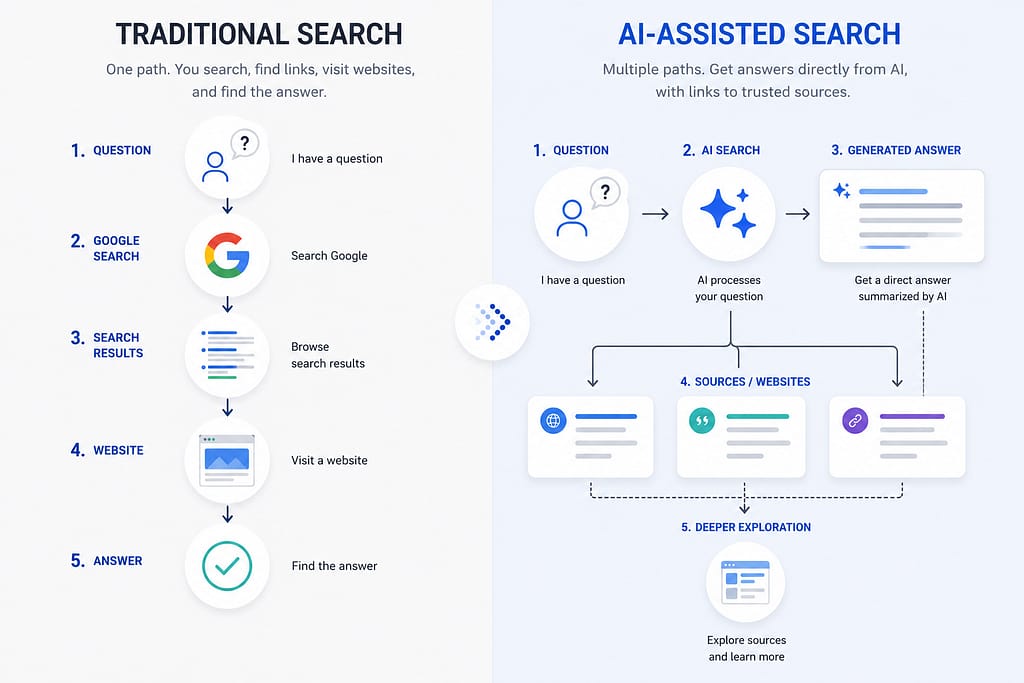
That still happens, but the same person can now ask ChatGPT, “What should I look for when choosing a property management company in Toronto?” They might ask Google a longer question and receive an AI-generated answer before reaching the traditional organic results. They can then ask a follow-up question without ever reformulating their thoughts into the short keywords we traditionally associate with search.
The customer’s intention has not fundamentally changed. They still have a question, a problem or a need. What has changed is how they interact with the information available online. Traditional search has largely been about helping users find webpages that may contain the information they need, while generative AI can increasingly retrieve information from multiple sources, interpret it and construct an answer on the user’s behalf.
That creates an important distinction for businesses. Online visibility is no longer only about whether your webpage ranks. It can also be about whether your information is understood, retrieved, referenced or used when an answer is generated. This is where all the new jargon begins.
SEO: Search Engine Optimization
SEO is the oldest and broadest concept of the four. At a basic level, Search Engine Optimization is about helping search engines discover and understand your website, while improving the likelihood that relevant pages appear when people search for something related to your business.
This covers far more than keywords. Technical accessibility, site architecture, internal linking, content quality, relevance, backlinks, local signals, structured information and user experience can all contribute to search performance.
There is sometimes an assumption that this model becomes obsolete once AI starts answering questions directly. However, that overlooks an important part of how modern AI search actually works. Google states that its generative AI search features are rooted in its existing Search ranking and quality systems. Pages still need to be discoverable and eligible to appear in Google Search before they can become supporting links in AI features such as AI Overviews and AI Mode. Google also states that there are no additional technical requirements or special schema that website owners need simply to appear in these AI features.
Therefore, SEO has not disappeared underneath AI search. In Google’s case at least, it remains part of the infrastructure that AI search is building upon.
AEO: Answer Engine Optimization
AEO stands for Answer Engine Optimization, and the idea actually predates the current AI boom. Search engines had already been moving away from simply displaying ten blue links for years. Featured snippets, knowledge panels and voice assistants all attempted, in different ways, to answer questions directly.
AEO therefore shifts part of the focus from whether a webpage can rank for a search to whether the information on that webpage can clearly answer the question. Someone searching for “condo management Toronto” may eventually want the same service as someone asking, “How do I replace my condo corporation’s current property management company?” However, the second query requires more than keyword relevance. It requires an actual explanation.
This encourages content that understands the questions behind a search: clear definitions, useful FAQs, logical headings, concise answers where appropriate and, importantly, enough supporting information to make those answers meaningful.
However, AEO should not be interpreted as an excuse to turn every website into hundreds of short Q&A blocks. A direct answer without depth may address the immediate question, but it does very little to demonstrate expertise. The answer matters, but so does the substance behind it.
AIO: AI Optimization — or AI Overviews?
This is where the terminology gets messy. AIO is sometimes used to mean AI Optimization, describing the broader practice of adapting content and a digital presence for AI-assisted discovery. In other SEO discussions, AIO is also used as shorthand for Google’s AI Overviews.
There is no reason to pretend this ambiguity does not exist. The vocabulary around AI search is developing almost as quickly as the technology itself. When we refer to AIO at MarketSign, we use the broader meaning of AI Optimization: making a company’s digital presence easier for AI-driven systems to understand, retrieve and interpret.
That can include content, but it should not stop there. Clear business information, consistent brand and entity signals, technical accessibility, original expertise, structured data where appropriate and a coherent website architecture all contribute to how understandable a business is online.
In this sense, AIO is less about finding a trick that makes ChatGPT mention your company and more about asking whether an AI system has enough reliable information to understand who you are, what you do and what you know.
GEO: Generative Engine Optimization
GEO, or Generative Engine Optimization, takes the idea one step closer to generative AI itself. The term gained wider attention following academic research examining how content visibility could be optimized within generative engine responses. Since then, GEO has increasingly been used to describe efforts to improve the likelihood that a brand or its content appears, contributes to, or is cited within AI-generated answers.
Traditional SEO is primarily concerned with improving the visibility of a webpage in search results. GEO introduces an additional concern: how do we improve the visibility of our information when an AI system generates the answer itself?
We are already beginning to see this become measurable rather than theoretical. Microsoft introduced AI Performance in Bing Webmaster Tools in 2026, allowing publishers to see how their webpages are being cited within supported AI-generated experiences. This tells us something important: visibility in AI-generated answers is becoming a real part of search measurement, even if the industry has not yet agreed on exactly what to call every part of it.
So, Which One Should a Business Focus On?
This is probably the wrong question. If we treat SEO, AEO, AIO and GEO as four separate marketing channels, we risk creating four strategies for what is fundamentally the same customer journey: someone is looking for information, and we want our business to be discoverable when that happens.
The difference is how the information travels from the business to the customer. SEO helps make your website discoverable and understandable in search. AEO places more emphasis on providing useful answers to specific questions. AIO considers how your broader digital presence can be interpreted in an AI-assisted environment, while GEO focuses more specifically on visibility within generative answers, including mentions, references and citations.
They have different areas of emphasis, but a large part of the foundation is shared. A website that search engines cannot crawl is not suddenly going to become excellent at GEO. Thin content does not become authoritative because it has been reformatted into an FAQ. Likewise, a business that barely explains its expertise online cannot reasonably expect an AI system to develop a detailed understanding of that expertise.
This is why we do not see GEO as a replacement for SEO. We see it as an evolution of the same problem.
AI Doesn’t Make SEO Less Important. It Makes Shallow SEO Less Valuable.
One question we increasingly hear is: if customers can simply ask ChatGPT for an answer, why should a business continue investing in SEO? At first, the logic seems reasonable. If AI provides an answer without requiring someone to open ten Google results, perhaps optimizing for traditional search should become less important.
But that conclusion assumes that AI somehow operates independently from the information ecosystem that search engines and websites have built over the past few decades. Google’s guidance on generative AI search makes the relationship particularly clear. Its AI experiences continue to use core Search systems to discover relevant web content, while Google continues to recommend familiar fundamentals such as technically accessible websites and useful, original, people-first content.
The implication is not that nothing has changed. Quite the opposite. If AI can generate a perfectly acceptable generic explanation of “what is SEO” in seconds, publishing another generic article saying exactly the same thing becomes less valuable. Content based on actual experience, original analysis, local knowledge, detailed examples, proprietary data or a genuinely useful point of view becomes much harder to replace.
AI doesn’t make SEO less important. It makes shallow SEO less valuable.
That is a subject worth exploring in much greater depth, and it will be the focus of another article in this series.
Perhaps We Need to Think Beyond SEO vs GEO
After looking at all four terms, another question starts to emerge. If SEO, AEO, AIO and GEO increasingly overlap, does a business really need four different optimization strategies, or are we simply looking at different parts of a much broader objective?
A customer searching Google for a local service, asking ChatGPT for a recommendation, reading an AI Overview or using another answer engine may behave differently in each environment. From the business’s perspective, however, the objective remains remarkably consistent: be visible when the right person is looking for something you know, provide or do well.
This is why at MarketSign, we are beginning to think about the next stage of search through a broader concept: Search Visibility Optimization, or SVO.
SVO is not intended to become another acronym competing with SEO, AEO, AIO and GEO. In fact, that would defeat the purpose. We see SVO as an umbrella approach: SEO remains the foundation, while answer engines, AI-assisted discovery and generative search expand the places where that foundation needs to create visibility.
Instead of focusing exclusively on “How do I rank higher on Google?”, the question therefore becomes broader: “How do I make my business visible wherever my customers search for answers?”
That distinction may become increasingly important over the next few years.
Introducing MarketSign’s AI Search Adaptation Series
This article marks the beginning of a new series at MarketSign: AI Search Adaptation. We chose that name deliberately because the terminology will change. New acronyms will appear. Some of today’s terms may become established disciplines, while others may eventually be absorbed back into SEO. Search platforms themselves will continue changing even faster.
Businesses should therefore be careful about rebuilding their marketing strategy every time a new acronym becomes fashionable. What matters is the underlying change in customer behaviour. People are still searching, researching and comparing businesses, products and services before making decisions. The difference is that an AI system may increasingly sit somewhere between the question and the source.
Throughout this series, we will examine that change from a practical business perspective. We will look at the relationship between SEO and AI search, what GEO can and cannot realistically achieve, how businesses can improve the depth and usefulness of their content, how AI visibility can be measured, and what platforms such as Google, ChatGPT and Microsoft are changing along the way.
We will also use MarketSign itself as part of that learning process, testing how our own content appears across traditional and AI-assisted search and documenting what we learn. We do not expect every assumption to prove correct; AI search is developing too quickly for anyone to reasonably claim that. Where data contradicts an assumption, that is useful information too.
Because ultimately, whether we call it SEO, AEO, AIO, GEO, SVO or something else in a few years, the business question remains remarkably similar: when somebody is looking for something your business knows, provides or does well, can they find you?
The route between that question and your business is changing. Our job is to adapt with it.